


Indigenous Referendum Rejected in Australia, 2023.
In a significant setback to Australia’s efforts for reconciliation with its Indigenous population, a proposal to recognize Indigenous people in the country’s constitution was decisively rejected on Saturday. The “No” vote led “Yes” by 57.35% to 42.65%, with 45% of the vote counted nationwide.
Several states, including New South Wales, Tasmania, Queensland, and South Australia, were projected to vote against altering the 122-year-old constitution for a successful referendum; at least four of the six states needed to vote in favour, along with a national majority. Voting was still underway in Western Australia as it became evident that the referendum was lost.

The proposal aimed to recognize Aboriginal and Torres Strait Islander people by establishing an Indigenous advisory body called the ‘Voice to Parliament.’ Indigenous leaders and supporters of the proposal hoped this structural change would promote unity and reconciliation in Australia.
However, the rejection of the referendum has left Indigenous leaders, academics, and human rights advocates devastated, fearing that reconciliation efforts could be set back by years.
Indigenous citizens, who have inhabited Australia for around 60,000 years, remain unmentioned in the constitution and are, by most socio-economic measures, the most disadvantaged group in the country.
The “Voice to Parliament” was part of the Uluru Statement from the Heart, a 2017 document outlining a reconciliation roadmap between Indigenous communities and the broader Australian population. Its proponents believed that enshrining an Indigenous Voice in the constitution would usher in a new era of cooperation with Australia’s Indigenous people.
The referendum’s outcome highlights the difficulties of passing referendums in Australia. Only eight of 44 referendums have succeeded since the country’s founding in 1901. This was the first referendum in Australia in nearly a quarter of a century.
In 1999, Australian voters rejected a proposal to become a republic. While a 1967 referendum to include Indigenous people in the Australian population was a resounding success with bipartisan support, the 2023 referendum did not enjoy unified political backing, with leaders of major conservative parties advocating for a “No” vote.
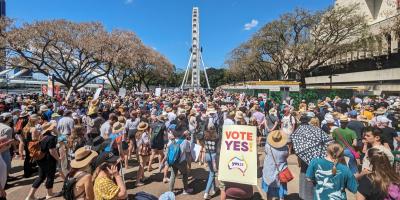
“The problem that the ‘Yes’ campaign had was they went and spoke to the leadership, the elites of this community, and they kept on saying: ‘We’ve got these communities’,” remarked Warren Mundine, a leader of the “No” campaign across the country.
The “Voice to Parliament” had been a significant feature of Prime Minister Anthony Albanese’s term in office. Political analysts consider a loss in the referendum to be his most significant setback since taking office in May the previous year.
Foreign Minister Penny Wong commented on the outcome: “The task ahead for us is to come together and chart a new path forward. I don’t know yet what that would be, but it’s something that we can do as a country.”
The Rejected Indigenous Referendum-
Australia’s Indigenous referendum, which aimed to recognize Indigenous people in the constitution, was rejected nationwide. With 45% of the vote counted, the “No” vote led the “Yes” vote by a substantial margin, with 57.35% against 42.65%. The rejection of the referendum was a significant blow to Australia’s ongoing efforts for reconciliation with its Indigenous population.
Several states, including New South Wales, Tasmania, Queensland, and South Australia, were projected to vote against altering the 122-year-old constitution. Passing a referendum requires the support of at least four of the six states and a national majority. The referendum’s fate was clear once voting in Western Australia was completed, but it ultimately ended in rejection.

The proposed constitutional change sought to recognize and empower Aboriginal and Torres Strait Islander people by creating an Indigenous advisory body called the ‘Voice to Parliament.’ Indigenous leaders and supporters of the proposal hoped that this structural change would lead to greater unity and reconciliation in Australia.
Indigenous citizens comprise 3.8% of Australia’s population and have a history of around 60,000 years. Despite their deep roots in the land, they are not mentioned in the constitution and face significant socio-economic disadvantages.
The “Voice to Parliament” was a vital component of the Uluru Statement from the Heart, a document crafted by Indigenous leaders in 2017. This statement laid out a roadmap for reconciliation between Indigenous communities and the broader Australian population.
Advocates of the proposal believed that enshrining an Indigenous Voice in the constitution would mark the beginning of a new era of cooperation and recognition for Australia’s Indigenous people.
However, the rejection of the referendum has left Indigenous leaders, academics, and human rights advocates deeply disappointed. They fear that this outcome could set back reconciliation efforts by many years.
Australia’s Struggles with Referendums-
Passing referendums in Australia has historically proven to be a challenging endeavour. Throughout Australia’s history since its founding in 1901, only eight out of 44 referendums have succeeded.
The rejected Indigenous referendum marked the first referendum in Australia in nearly a quarter of a century. In 1999, Australian voters also rejected a proposal to transform the country into a republic.

In contrast, a 1967 referendum to count Indigenous people as part of the Australian population enjoyed significant success, with strong bipartisan political support. However, the 2023 referendum did not receive unified political backing, as leaders of major conservative parties campaigned for a “No” vote.
The Political Divide-
The outcome of the referendum underscored a deep political divide. Those supporting the “Yes” campaign were seen as primarily appealing to leadership and elites, while opponents argued that the referendum’s focus on structural change distracted from achieving practical and positive outcomes. Political opposition also criticized the measure as divisive, potentially ineffective, and a hindrance to government decision-making.
The “Voice to Parliament” had been a central feature of Prime Minister Anthony Albanese’s term in office. Political analysts consider a loss in the referendum to be his most significant setback since coming to power in May of the previous year.
Moving Forward-
In the wake of the referendum’s rejection, Foreign Minister Penny Wong emphasized the importance of coming together and finding a new path forward.
The way toward reconciliation in Australia may need to be reconsidered as the nation grapples with this significant setback in its efforts to recognize and empower its Indigenous population. While the future remains uncertain, there is a shared sense of responsibility to find a way to move forward as a country.


